Nar Phu Valley Trek - 12 days

Things to Know
  • Duration12 Days
  • Difficulty Level Strenuous
  • Altitude Kang La Pass ( 5,320m)
  • Trip Type Trekking
  • Start and End Kathmandu and Kathmandu
  • Best Time Autumn and Spring
What You’ll Do
  • Venture into the lesser-explored corners of the Annapurna region
  • Walk through a unique eco-touristic trail rich in nature and culture
  • Enjoy panoramic views of the Annapurna Range, Mt. Manaslu, Dhaulagiri, Annapurna II, Himlung Himal, Gangapurna, and Tilicho Peak
  • Cross the challenging and scenic Kang La Pass (5,320m)
  • Discover remote Tibetan settlements and stunning Buddhist monasteries
  • Stay in traditional villages that preserve their ancient way of life
  • Visit the untouched and spiritually rich villages of Nar and Phu
  • Walk along the edge of the Tibetan Plateau and experience authentic Tibetan-influenced culture

The Nar Phu Valley Trek via Kang La Pass is one of Nepal's most remote and rewarding trekking adventures, located in the restricted Annapurna region near the Tibetan border. Open to foreign trekkers since 2003, this hidden valley offers an unforgettable journey through ancient Tibetan villages, dramatic gorges, Buddhist monasteries, yak pastures, and breathtaking Himalayan landscapes. The trek begins from Dharapani, following the Annapurna Circuit to Koto before entering the hidden Nar Phu Valley. Along the way, you'll visit the traditional villages of Meta, Phu, and Nar, experience authentic Tibetan culture, and enjoy spectacular views of Annapurna II, Gangapurna, Himlung Himal, Manaslu, Tilicho Peak, and Chulu Himal.

One of the trek's biggest highlights is crossing Kang La Pass (5,320m), which connects Nar Village with the Annapurna Circuit near Ngawal. For a longer adventure, the trek can continue across Thorong La Pass (5,416m) to the sacred pilgrimage site of Muktinath before ending in Jomsom and Pokhara. As a restricted area trek, visitors require a Restricted Area Permit (RAP), Annapurna Conservation Area Permit (ACAP), and a government-licensed trekking guide. Thanks to its location in the rain shadow of the Himalayas, the Nar Phu Valley is also one of Nepal's best trekking destinations during the summer monsoon season.

Why Nar Phu Valley Trek

The Nar Phu Valley Trek is one of the finest off-the-beaten-path adventures in the Annapurna region, perfect for trekkers seeking raw nature, organic trails, and deep cultural authenticity. Far from modern development, this remote journey leads through timeless villages such as Meta, Phu, and Nar, Ngawal, where life continues much as it has for centuries—without modern amenities, yet rich in tradition, spirituality, and Himalayan hospitality. The trail winds through dramatic gorges, high alpine landscapes, and untouched terrain, offering a true sense of exploration. The highlight of the trek is crossing Kang La Pass (5,320 m / 17,454 ft), a spectacular and remote mountain gateway linking the isolated Nar Valley with the Annapurna region. Beginning before sunrise, the demanding ascent rewards trekkers with a breathtaking panoramic view of Annapurna II, Gangapurna, Tilicho Peak, Pisang Peak, and the vast Damodar Himal, with prayer flags dancing in the mountain wind—an unforgettable moment that defines the magic of the Nar Phu Valley Trek.

A Hidden Valley Closed Until 2002

For many years, Nar Phu Valley was closed to foreign visitors because of its location near the Tibetan border. This isolation helped preserve the region's traditional culture, architecture, and natural beauty. Even today, the valley remains one of Nepal's least-visited trekking destinations, making it an ideal choice for those looking to experience the Himalayas away from the crowds. Walking through Nar and Phu villages feels like stepping back in time. Stone-built houses, centuries-old monasteries, yak caravans, and peaceful mountain life continue much as they have for generations.

Special Permits Required

The Nar Phu Valley Trek is a restricted area trek, so trekkers must obtain a Restricted Area Permit (RAP) and an Annapurna Conservation Area Permit (ACAP) before entering the region. A licensed trekking guide is mandatory, and permits can only be arranged through a registered trekking agency in Nepal. These regulations help protect the valley's fragile environment, unique culture, and border security while supporting sustainable tourism.

Rich Tibetan Culture

Nar Phu is one of the best places in Nepal to experience authentic Tibetan culture. The local communities continue to practice Tibetan Buddhism alongside ancient Bon traditions. Visitors can explore centuries-old monasteries, traditional villages, prayer wheels, mani walls, and sacred chortens while learning about the local way of life. The famous Tashi Lhakhang Monastery near Phu Village remains one of the valley's most important spiritual landmarks and attracts both pilgrims and trekkers.
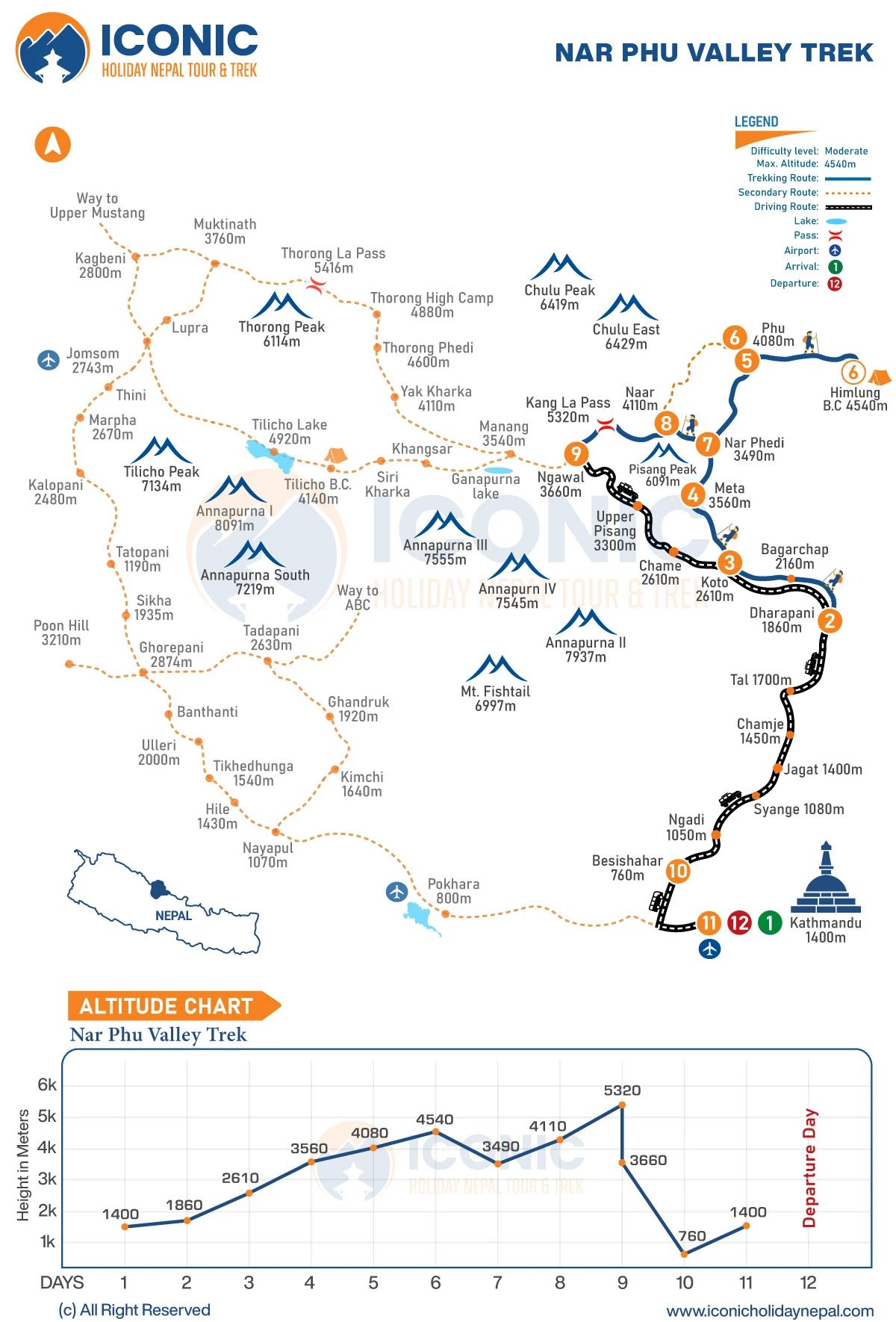

Itinerary
Expand AllCollapse All

  • Altitude1400 m
  • AccommodationHotel
  • Time1-2 hrs

Our representative will arrive at Tribhuvan International Airport on time based on the timing of your flight. They will drive you to the hotel and assist you with check-in. After a rest in your hotel, you can walk around the city.

  • Altitude1860 m
  • AccommodationTea House
  • Time224 km | 9hrs

The drive from Kathmandu to Besisahar starts early, winding through scenic hills, terraced fields, and riverside villages along the Prithvi Highway. After about 5-6 hours, we reach Besisahar, the gateway to the Annapurna Circuit. From here, a 4WD jeep takes us on a bumpy off-road ride along the Marsyangdi River, passing waterfalls and charming villages like Syange and Jagat. The 3–4-hour drive to Dharapani (1,860m) offers stunning mountain views.

  • Altitude2610 m
  • AccommodationTea House
  • Time4-5 hrs

The trek from Dharapani to Koto takes around 4 hours. The valley extends westward through thick Fir and Pine forests. After 30 minutes of walking, we reach Bagarchap (2,160m). From there, we will walk through Danaque and Temang Village. The view of Manaslu, Lamjung Himal, and Annapurna Himal (1 and 2) is breathtaking. From Temang, we will trek to the higher and dry areas of the Manang Valley. The path uphill is flat to Thanchowk, from where we will trek to Koto to spend the night. Koto is a small village mainly inhabited by Gurungs who follow Tibetan Buddhism.

  • Altitude3560 m
  • AccommodationTea House
  • Time6-7 hrs

Today, we enter the restricted area, complete entry formalities. The trail takes us through pine forests, along the Soti Khola (river), and over rocky terrain. We can see caves and canyons on the way.  We stop for lunch, most likely at Dharmasala village, before reaching Meta, where we stop for the night.  Views of Annapurna II and Lamjung Himal fill the skyline.

  • Altitude4080m
  • AccommodationTea House
  • Time6-7 hrs

After enjoying a fantastic breakfast with a magnificent view of Meta, your journey will begin. At the start of the Nar Phu Valley  Trek, you will come across stunning monasteries and vibrant Tibetan chortens with flying prayer flags.  Before reaching Phu gate, the entrance to Phu Village, you would have passed the Phu Khola. The village offers breathtaking vistas of several Himalayan mountain ranges, including Himlung Himal and surrounding mountains. 

  • AltitudeHimlung Base Camp 4540m
  • AccommodationTea House
  • Time5-6 hrs

Phu Gaon is a big village situated in the Annapurna region of Nepal. There are around 50-60 local houses. Most of the people are Sherpa and follow Tibetan culture and traditions. Acclimatisation is best done by keeping active, so we head off for a hike to Himlung Himal Base Camp and a glacier valley. You will also visit Tashi Lhakhang Monastery, a must-see location in Phu Village.

  • Altitude3490 m
  • AccommodationTea House
  • Time5-6 hrs

Today, we have to make our way up to Nar Phedi. It will take around 5 hours to reach Nar Phedi from Phu Gaon. The route has a gradual descent as we move towards the low altitude. First, we retrace our original route to Meta. Then, we take a different route leading us to the Nar Phedi monastery. This monastery is actually our accommodation for the night. We stay with the welcoming nuns and join them in the Kitchen. We plan to join the nuns at the Puja session in the evening.

  • Altitude4110m
  • AccommodationTea House
  • Time3 hrs

Today, no longer hiking. It is just 3 hrs trek. The path is very dry and rocky. As it is a short-duration trek, we will have our lunch after reaching Nar Village. Nar village is one of the big villages in this area. There are around 100 local houses, and most of the people residing in the region are Sherpa and Tibetan. The main source of income for the people is agriculture; they grow wheat and buckwheat. Most of them are also engaged in running teahouses. The local people also raise cattle, such as yaks, cows, and sheep. There is an old monastery in this village, which we can explore after having lunch and resting for a while.

  • AltitudeKang La Pass (5320m)
  • AccommodationTea House
  • Time6-7 hrs

This is one of the most challenging yet rewarding days of the Nar Phu Valley Trek. The steep ascent from Nar village to Kang La Pass (5,320m) takes about 5–6 hours, offering breathtaking views of the Annapurna range, Himlung Himal, and Humde Airport. We will provide a packed lunch, which you'll enjoy at the top of the pass while taking in the stunning Himalayan panorama. After a well-deserved break, we descend to Ngawal—a 3–4 hour trek down a steep trail, which can be slippery in winter due to snow. Ngawal is a quiet traditional village with 40–50 homes, inhabited by Sherpa and Tibetan families. Locals are involved in Yarshagumba collection and running teahouses to welcome trekkers.

  • Altitude760 m
  • AccommodationHotel
  • Time6-7 hrs

From Ngawal, we’ll begin our journey back to Besisahar by jeep, as buses do not operate in this area. The village is directly connected by a rough road, and while motorbikes can also access Ngawal, jeeps are the most reliable mode of transport. The drive takes around 6–7 hours, with most of the route being off-road—only about 10 kilometers are paved. We’ll stop for lunch en route, enjoying the final stretch of this adventurous Himalayan journey.

  • Altitude1400 m
  • AccommodationHotel
  • Time6-7 hrs

Driving from Besisahar to Kathmandu, approximately 176 kilometres (109.3 miles), typically takes 6 to 8 hours, depending on traffic and road conditions. The route primarily follows the well-maintained Prithvi Highway with stunning views of lush green hills, valleys, and rivers, including the Marshyangdi River.

    After breakfast and 3 hours prior to your scheduled flight, one of the representatives will transfer you to the airport and bid farewell.

    Trip Cost Details
    Included
    • Airport Transfer: Pick-up and drop-off services for both international and domestic flights.
    • Hotel Stay: 3 star hotel accomodation in Kathmandu with breakfast
    • Transportation: Comfortable Transfer during the trek  | Via Local Jeep or Public Bus
    • Tea House Accommodation: Twin-sharing tea house accomodation during a trek
    • Meals on Trek: Full board (breakfast, lunch, and dinner) and seasonal fruits 
    • Experienced Trekking Guide: English-speaking guide with salary, food, equipment, and insurance covered.
    • Porter Service: Porters to carry luggage (1 porter for every 2 trekkers, with a 9 kg per trekker limit).
    • Permits: All necessary trekking permits | Restricted Area Permit and Annapurna Conversation Area Permit
    Excluded
    • International Flight Ticket
    • Nepal visa fees | Nepal Visa Information
    • Foods in Kathmandu.
    • Personal Trekking equipments
    • Tips for guides and Porters | Expected
    Useful Info

    Best Season for Nar Phu Valley Trek

    The Nar Phu Valley Trek is one of Nepal's finest remote Himalayan adventures and can be completed throughout the year except during the peak monsoon season. However, the best time for the Nar Phu Valley Trek is spring (March to May) and autumn (September to mid-December), when weather conditions are stable, mountain views are crystal clear, and the trails are at their most beautiful. These seasons provide the ideal balance of comfortable temperatures, excellent visibility, and safe trekking conditions for crossing the challenging Kang La Pass (5,320 m).

    Spring (March to May) is a spectacular season for trekking in the Nar Phu Valley. Mild daytime temperatures, clear blue skies, and fresh mountain air create excellent trekking conditions. As the snow begins to melt, the landscape comes alive with blooming rhododendrons, alpine flowers, and lush forests in the lower elevations. Higher sections remain cool but comfortable, offering breathtaking views of Annapurna II, Gangapurna, Tilicho Peak, Himlung Himal, Pisang Peak, Chulu East, and Manaslu. The longer daylight hours also make acclimatization and daily walking more enjoyable.

    Autumn (September to Mid-December) is considered the most popular trekking season in Nepal and offers exceptional conditions for the Nar Phu Valley with Kang La Pass Trek. After the monsoon, the skies become remarkably clear, revealing uninterrupted Himalayan panoramas. The air is crisp, rainfall is minimal, and temperatures remain pleasant during the day while becoming cooler at night. Traditional villages are surrounded by golden fields ready for harvest, creating beautiful scenery alongside dramatic mountain landscapes. October and November are particularly ideal for photography, cultural experiences, and crossing high mountain passes.

    Nar Phu Valley Trek Accomodation

    Accommodation during the Nar Phu Valley Trek is basic but comfortable, reflecting the untouched nature of this restricted Himalayan region. In Kathmandu, trekkers stay in well-appointed tourist hotels, while accommodation along the trekking route is provided in traditional family-run teahouses and mountain lodges. Rooms are generally twin-sharing with simple beds, mattresses, pillows, and blankets, while bathrooms are shared and may be either Western-style or traditional squat toilets depending on the village. Hot showers, battery charging, Wi-Fi, and laundry services are available in some villages for an additional charge, although facilities become more limited as the trail reaches remote settlements such as Meta, Kyang, Phu Gaon, Nar Village, and Ngawal. Carrying a warm sleeping bag, power bank, personal toiletries, and essential trekking gear is strongly recommended, especially during colder months.

    Nar Phu Valley Trek Difficulty

    The Nar Phu Valley Trek with Kang La Pass is considered a moderate to challenging trekking adventure and is best suited for trekkers with good physical fitness and some previous high-altitude trekking experience. The route passes through isolated valleys, narrow canyons, glacier-fed rivers, ancient Tibetan villages, and rugged mountain terrain, with most overnight stops located above 3,000 meters. The biggest challenge is crossing Kang La Pass (5,320 m), which requires endurance, careful pacing, and proper acclimatization. Daily walking typically ranges from 6 to 8 hours, with occasional longer days depending on the itinerary. Although no technical climbing skills are required, trekkers should be prepared for steep ascents, rocky trails, changing mountain weather, and the possibility of Acute Mountain Sickness (AMS). With proper preparation, gradual acclimatization, experienced guides, and a positive attitude, the Nar Phu Valley Trek rewards adventurers with one of Nepal's most authentic trekking experiences, featuring dramatic Himalayan scenery, ancient Tibetan Buddhist culture, centuries-old monasteries, and some of the least-visited landscapes in the Annapurna region.

    Our global team of experts is here to assist you.

    Need Travel Advice